
As the flowers fade, the shapes and textures behind summer’s display become easier to see. Now it’s a perfect time to notice which plants hold your garden together. Maybe it makes you appreciate them a little more.

From the Garden:
It’s raining outside. Behind my window, the red hips of ‘Above and Beyond’, our rambling rose, shimmer with water droplets. The trees and hedges have already lost their fiery, colorful leaves, leaving the landscape in shades of brown, yellow, and deep green. The evergreens stand quietly in the steady rain.
It’s still exceptionally warm for October. The lawn is green, and the perennials are slowly turning yellow. A few flowers linger: Autumn Joy sedums, hydrangeas, tiny sweet violets, and the last blooms of ‘Rozanne’ hardy geranium.
But the abundance of summer has passed.
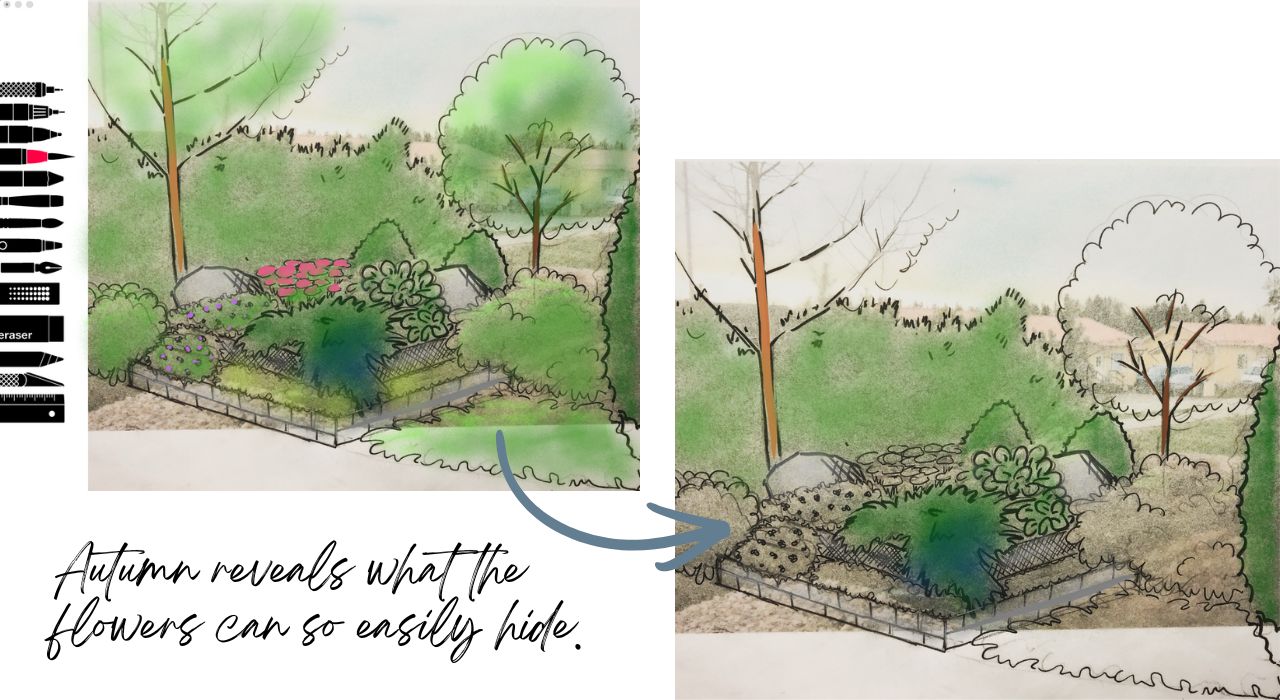
I like looking at the garden at this time of year. There is more space to see the shapes of individual plants and how they sit together. Things that were almost invisible among the summer flowers become much easier to notice.
Autumn reveals what the flowers can so easily hide.
The Design Note:
What remains in a garden bed when the flowers fade?
This is a question I ask when designing a garden, whatever the season. In summer, I have to imagine the planting without its flowers. In late autumn, much of that framework is already there to see.
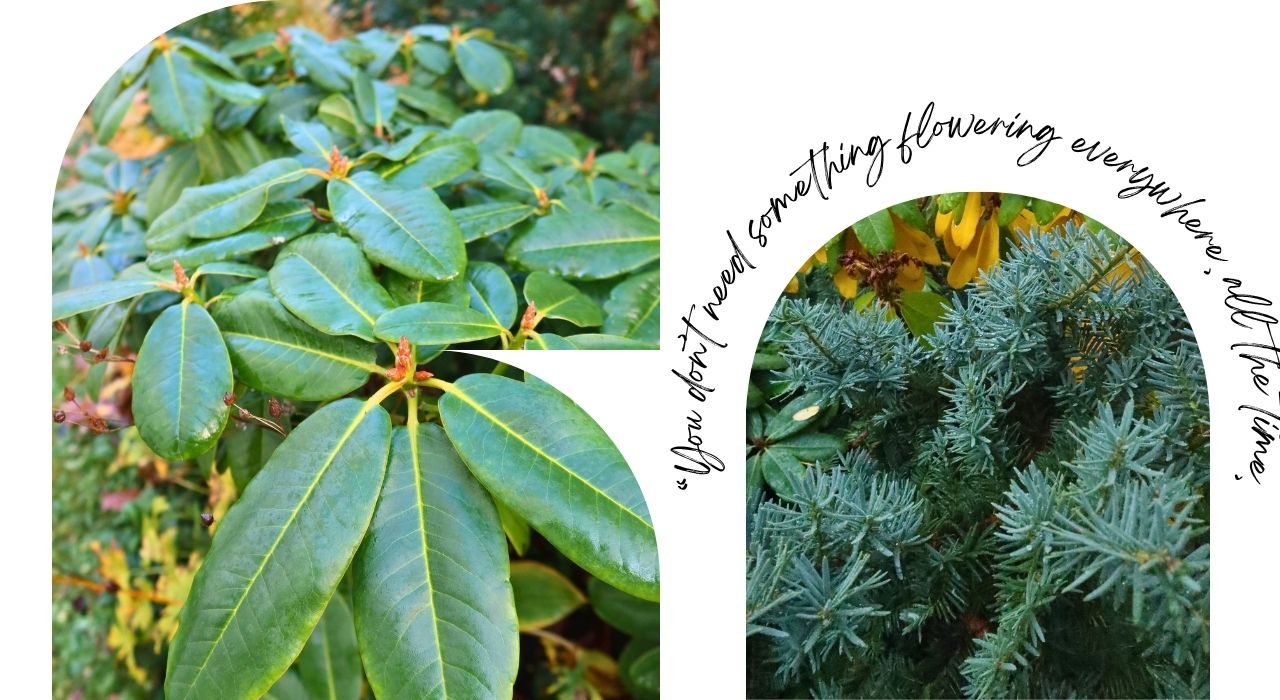
A hedge continues to frame the space. An evergreen gives a planting bed a substantial shape. The branching silhouette of a small tree becomes more noticeable as its leaves fall.
These plants help hold the garden together while the flowering plants move through their seasons.
When I visit a client’s garden in summer, our attention naturally goes to the flowers. I enjoy them too, of course. But I’m also looking at what supports that beautiful display. What gives the bed shape? What connects it to the rest of the garden? What will we see from the kitchen window in November?
I use quite a lot of evergreens in my designs. In the cold-climate gardens where I mostly work, these are often conifers. I appreciate the variety of shapes and textures they bring, and how their presence becomes more noticeable as the garden settles toward winter.
But the framework doesn’t have to be entirely evergreen. A deciduous shrub with a graceful branching habit can be lovely against a quiet background. A small tree with beautiful bark may become one of the most interesting things to look at.
You don’t need something flowering everywhere, all the time, for a garden to feel thoughtfully composed.
The flowers bring change: anticipation, abundance, and the lovely sense of one season giving way to another. The trees, shrubs, and evergreens give that changing display a setting.
As you look at your garden this autumn, notice which plants still give it shape. You may discover that a quiet plant you barely noticed in June is now doing a great deal for the whole view.
Related Read
If you’d like to explore this further:
3 Essential Evergreen Tips for Year-Round Beauty

A Small Practice
Take two minutes to look at one garden bed. You can step outside or simply look through a window.
Let your eyes settle on what remains after the flowers have faded.
Which plant or feature still gives the bed a sense of shape?
Perhaps it’s a rounded evergreen, the line of a hedge, or the branches of a shrub.
There’s no need to plan any changes. For now, just notice what is quietly holding that view together.
If You’d Like to Go Further
The framework gives your flowering plants a setting. Within it, you can plan a succession of blooms that brings something new to enjoy from spring to fall.
That’s what I teach in the Bloom Flow Method, my upcoming online course. If you’d like to learn how to plan a flower bed with a thoughtful sequence of blooms, you’re warmly welcome to join the waitlist.
Over to You:
What remains in your garden after the flowers fade?
I’d love to hear about a plant or feature you’re appreciating now. Just leave a comment below and tell me.
Enjoy these last autumn days.
Garden wishes,

Your Garden Design Mentor

P.S. If this Garden Blueprint made you think of a gardening friend, I’d love for you to share it with them.
And if you're reading online and haven't subscribed yet, join The Garden Blueprint to receive the next one in your inbox.


Responses