
When something leaves the garden, it can make room for something more intentional.

From the Garden:
We recently took a good, honest look at our garden.
After 26 years, some plants simply needed to go.
Some had become overgrown and cramped. Some had done their job beautifully, but had come to the end of their life cycle. And some were just quietly taking up space that was ready for something new.
It felt a little like saying goodbye.
But also like opening a door.
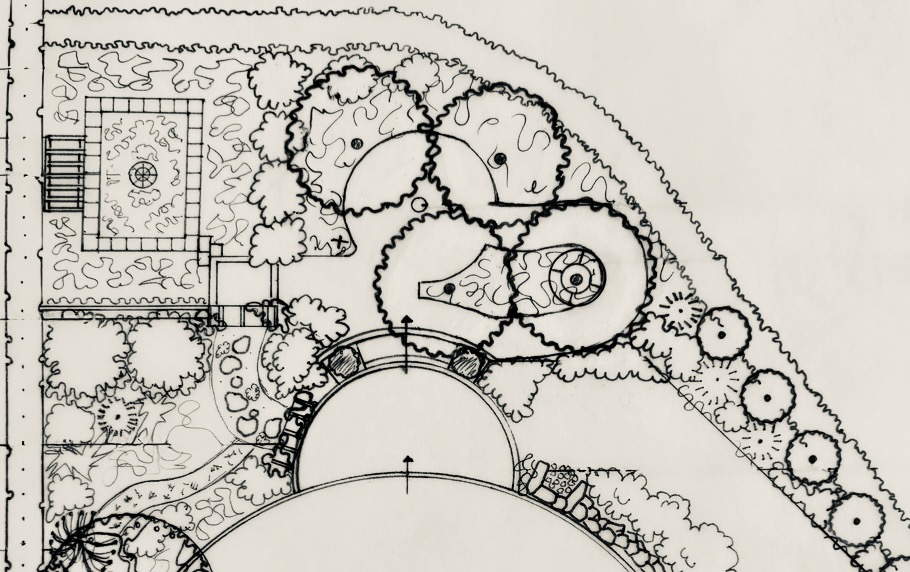
One of the spaces we cleared had been more open in my original garden design from 2003. Over the years, I had considered that there might be a nice place for a garden bench. Somehow, that bench never found its way there.
But after removing three overgrown dwarf thujas, the opportunity came back.
Now there’s space for the bench to become a focal point, and a place to sit and look back at the house from the terraced lawn.
Funny how an old idea can wait patiently in the background, isn’t it?
Sometimes you’re not only removing something that no longer works. You are making room for dreams to appear.
Maybe there’s something in your garden that’s ready to be let go of, too.
- An overgrown shrub.
- A tired planting.
- A corner that no longer feels like you.
And maybe, once it’s gone, you’ll see the space with completely fresh eyes.
The Design Note:
Before you fill a new open spot
When you remove something from your garden, it can feel tempting to fill the empty space right away.
A quick trip to the garden center.
A cart full of pretty plants.
A little excitement, a little hope, and maybe a feeling of, “This will fix it.”
But before you hurry to fill that new open spot, take a pause.
Truly look at what the space is offering you now. You have removed something, and that allows you to see that space anew.
Maybe the light conditions have changed over time as surrounding plants have grown. Maybe your needs for the space have changed, too.
Look at the space carefully, as each part of the garden has its own growing conditions. Even two planting areas in the same yard can behave differently.
So before choosing new plants, notice:
- How much light does this spot receive?
- Is the soil usually dry, moist, or somewhere in between?
- Does water drain away easily, or does it sit there?
- What kind of soil are you planting into?
- What role does this spot need to play in the whole garden?
That last question is just as important as the practical ones.
- Does this area need structure?
- Softness?
- Color?
- Privacy?
- Movement?
- A quiet focal point?
- A place to sit?
When you take the time to understand both the growing conditions and the space's design role, your plant choices become much clearer. You don’t need to consider all the plants in the garden center anymore. You can focus on the ones that truly match your conditions and the design needs for the plant you are looking for.
Instead of asking, “What pretty plant should I buy?”
You begin asking, “What would be a perfect match here?”
That is a very different question.
It is the kind of question that helps your garden feel more designed.
And if you’re working with a brand-new garden space, a yard that's yet unfamiliar to you, or your plants are struggling to thrive, start with my Sun & Shade Shortcut video below. I hope it helps with aspects.
|

A Small Reminder for Choosing Plants:
Do some homework before buying plants, and your garden will reward you.
With healthier growth.
Less fuss.
And plants have a much better chance of settling in and thriving in your garden.
Because when you choose the right plant for the right place, you are not only making your garden prettier.
You are helping plants become stronger.
A plant that is growing in conditions it enjoys is not using all its energy just trying to survive. It can grow with more vitality and often with more natural resistance to stress, pests, and disease.
How wonderful is that?
So before you fill a newly opened space, check the basics first:
- Light.
- Moisture.
- Drainage.
- Soil.
This is exactly what I help you do inside Confident Plant Choices.
No fluff. No complicated garden science.
Just a clear way to walk through the growing conditions of your planting area, so you can understand what your space offers and choose plants that actually match.
You can use the same process every time you open up a new area, refresh a tired planting, or plan what to plant next.
Check Confident Plant Choices here
Because when the site’s growing conditions and the plant’s needs align, gardening starts to feel less like guessing.
And more like understanding your garden.
A Question for You🌱:
Have you recently taken a good, honest look at your yard and decided to remove something?
Maybe an overgrown shrub, a tired planting, or something that didn’t feel right anymore?
Comment below: What are you planning for that freed-up space?
A bench?
A new planting area?
A path?
A little view you can enjoy from the house?
I’d love to hear what you’re making room for.


P.S. Enjoying The Garden Blueprint? Subscribe to receive future garden design notes, seasonal reflections, and practical design guidance straight to your inbox.



Responses