
How to Prevent Garden Overrun in a Woodland Edge Garden
A woodland edge garden can feel soft and beautiful, but it often comes with one big worry: what happens when the forest starts creeping into your planting border? Here are 3 simple ways to plan the space so it feels natural, calm, and easier to manage.
If you garden at the edge of a woodland, you probably know this feeling.
You love the trees. You love that soft, settled atmosphere. You want the garden to feel connected to the landscape around it, not cut off from it.
But there’s often a little worry sitting in the background, too.
What if the woodland starts creeping in?
What if seedlings begin popping up everywhere, roots start pushing into the border, and the whole thing slowly becomes more work than you expected?
It’s a real concern. And if you’ve been thinking about that, you’re definitely not the only one.
The good news is that this usually isn’t about doing something wrong. And it doesn’t mean you need to give up on the woodland edge look either.
Most of the time, it comes down to planning.
Because in a woodland edge garden, the goal isn’t to fight nature. It’s to shape the space so the garden and the woodland sit together beautifully.
And when that’s done well, the whole garden feels calmer, more coherent, and much easier to live with.
Why does this worry come up so often in a woodland edge garden?
A woodland edge is naturally active.
Nature is always trying to fill the empty spaces. Seedlings appear. Roots travel. New growth finds its way into places you hadn’t planned for. And if the layout hasn’t been thought through carefully, the planting border can start to feel like it’s constantly under pressure.
That’s often when the garden begins to feel less beautiful and more tiring.
Not because the idea was wrong. But because the transition between the garden and the woodland needs a bit more structure.
That’s really what this comes down to.
A woodland edge garden can feel soft and natural without feeling vague or difficult to manage.
3 ways to prevent garden overrun in a woodland edge garden
1. Think carefully about what’s behind the border
This is one of the biggest considerations, and it’s easy to miss at first.
When people plan a border, they often focus on the planted area itself. But in a woodland edge garden, what happens behind the border matters just as much.
- How much room is there?
- What’s growing there already?
- How easy will it be to maintain that area later on?
- Are there nearby trees that are likely to produce a lot of seedlings?
These are the kinds of things that make a difference over time.
Because if the area behind the border is left too undefined, that’s often where the creeping-in feeling begins. Nature sees a gap and starts filling it.
So before you even get into the finer planting details, it helps to step back and look at the wider setting. The border is never just the border. It’s part of a bigger relationship between the garden and the woodland beyond.
2. Plan the space in three zones, not just one
This is such a helpful way to think about it.
Instead of seeing the border as one separate strip of planting, try thinking in three connected zones:
- the area in front of the border,
- the border itself,
- and the area behind the border
That small shift makes the whole design feel clearer.
Because the success of a woodland edge garden rarely comes from the border alone. It comes from how those three areas work together.
- What happens in front affects how the border is seen and used.
- What happens behind affects how manageable it is over time.
- And the border itself needs to sit comfortably between the two.
When those three zones are considered together, the garden feels much more settled. More intentional. More at ease.
And that’s often what stops the space from drifting into that overrun feeling.
3. Use dense planting to help the border hold its shape
This is one of the simplest and most useful things you can do.
A densely planted border doesn’t just look lovely. It helps practically, too.
When the planting is full and layered well, it becomes harder for new seeds to germinate in open gaps. That alone can make a big difference. And when little re-sprouts or seedlings do appear, they’re much easier to spot and remove before they become a bigger problem.
Dense planting also helps the border keep its overall look.
That’s important because in a woodland edge garden, you usually want that planting to feel lush, soft, and grounded. A strong planting scheme helps the border stay tidy without making it feel stiff.
So you’re not trying to create a bare, controlled space.
You’re creating a full, generous planting that can quietly hold its own.
🌿The goal is a smooth flow, not a hard line
This part matters a lot in a woodland edge garden.
You want that lovely, smooth transition from the garden area into the planting border and then on to the trees beyond. That’s part of what makes this kind of garden feel so special.
So the methods you use to manage the space should support that flow, not interrupt it.
You don’t want your eye snagging on something harsh or distracting. You want the whole space to feel easy and natural, as though the woodland beyond belongs to the garden too.
And really, that’s where the beauty of this kind of design lives.
Not in trying to control every little thing.
But in creating a structure that feels so natural, you almost don’t notice it’s there.
Let the garden flow, but give it structure
If you’ve been worried about garden overrun, that worry makes sense.
But it doesn’t mean a woodland edge garden is bound to become messy or difficult. It simply means that the layout, transitions, and planting need thoughtful planning from the beginning.
And when those pieces are in place, the garden can feel exactly the way you hoped it would.
Soft. Natural. Beautiful. And much easier to maintain over time.
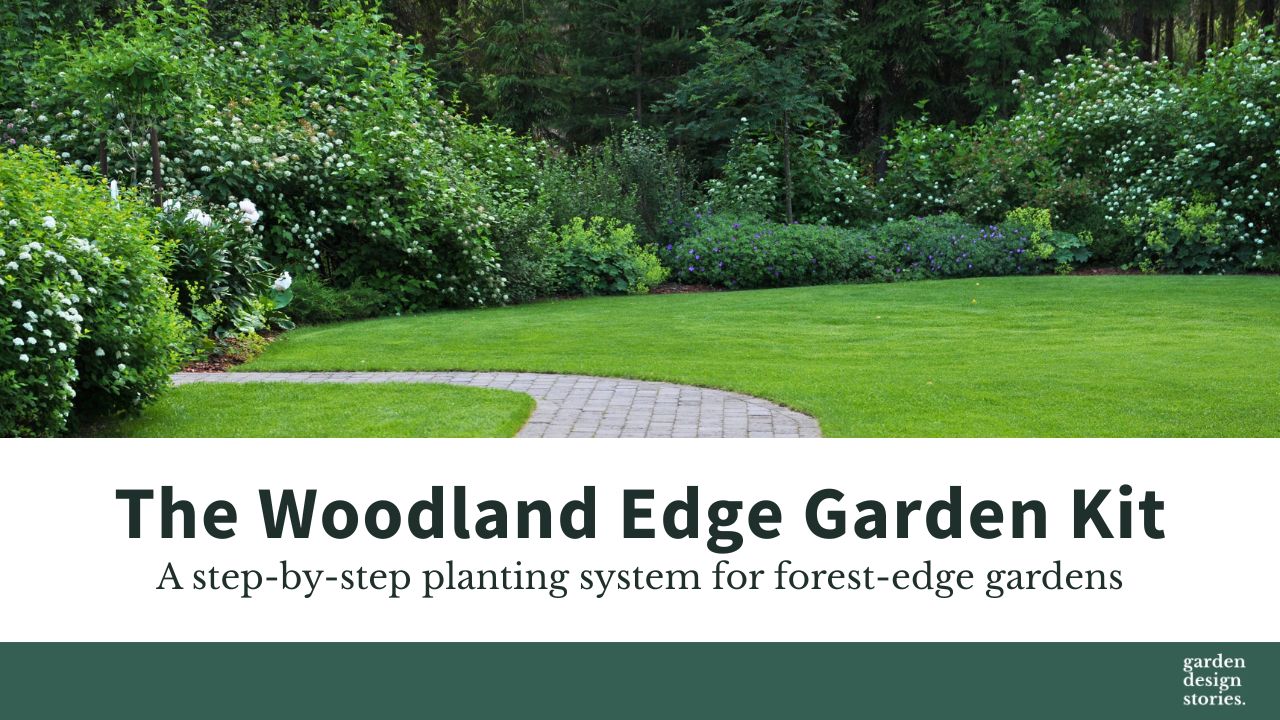
If you’d like more help with the layout, planting plan, and how to make it work in your own garden, you can explore my Woodland Edge Garden Kit here:
https://www.gardendesignstories.com/the-woodland-edge-garden-kit
Inside, I go deeper into how to place the border, how to consider the surrounding space, and how to adapt the design so it fits your own garden more naturally.
It’s designed for USDA hardiness zones 4–6 and includes the layout and planting plan, along with guidance on adapting it to your space.

Want to Discover Your Garden Style?
Take my popular Garden Style Quiz to find out which outdoor aesthetic suits you best—and get tailored ideas for building a garden you love.
